Showing posts with label Nature. Show all posts

Saturday, May 26, 2012

Turkey Vultures and Howler Monkeys

An early morning ride into the rain forest together with Jens, my good luck charm, resulted in encounters with Turkey Vultures and Howler Monkeys.  

First we walked through the old Fort Sherman residential area where the roads are slowly getting taken over by the jungle.  The buildings have all been taken down long ago leaving behind only the foundations.  

This time we were fully coated with bug spray and I was equipped with my Nikon D70S with the Nikkor 70-200mm zoom lens.  

Jens spotted some Turkey Vultures just ahead so we got off the bikes, and I walked slowly up as far as possible before they got spooked and flew off.  Such large birds!  Not the most beautiful of faces, but rather lovely in flight.
Turkey Vulture sitting on a fire hydrant.  There were three of them nearby.

I wouldn't want his claws anywhere near me!

Turkey Vulture flying off.  
We continued on and after a stop at the beach and some shell collecting, we rode further into the rain forest until we could hear the Howler Monkeys.  They were very close to the road and were on the move.  We stood and watched as a troop of about 20 monkeys moved through the tops of the trees from one side of the road to the other and then off deeper into the forest.  We were treated to their barks, howls, grunts and clicks.  They are almost as intriguing to listen to as they are to watch.


Howler Monkeys on the Move


The baby holding on to Mom and keeping an eye on us.


Baby on board!

The cojones swinging in the breeze  ;-)  


Saturday, May 19, 2012

The Sounds and Colours of a Rainforest

Shelter Bay Marina is right next to a National Park and what used to be a US Army base called as Fort Sherman. The national park is known for bird watching, butterflies, frogs, sloths and monkeys. We've been here over a week and it was time to explore.

Jens and I took a bike ride down the road towards San Lorenzo hoping to spot a sloth. We heard the usual forest sounds of birds, insects and frogs. And then we heard the Mantled Howler. Their loud grunts and roars are something out of a horror movie. We stopped to listen for a while and although we couldn't see the Howlers we spotted some White-faced Capuchins in the trees. Unfortunatley we forgot the bug spray and the Mosquitos soon found us, forcing us to retreat back to the road and back on the bikes. We tried to spot a Toucan, but just saw a lot of butterflies. The easiest to identify are the Blue Morphus Butterfly. They are really beautiful to watch as they flit along, but so very difficult to photograph.

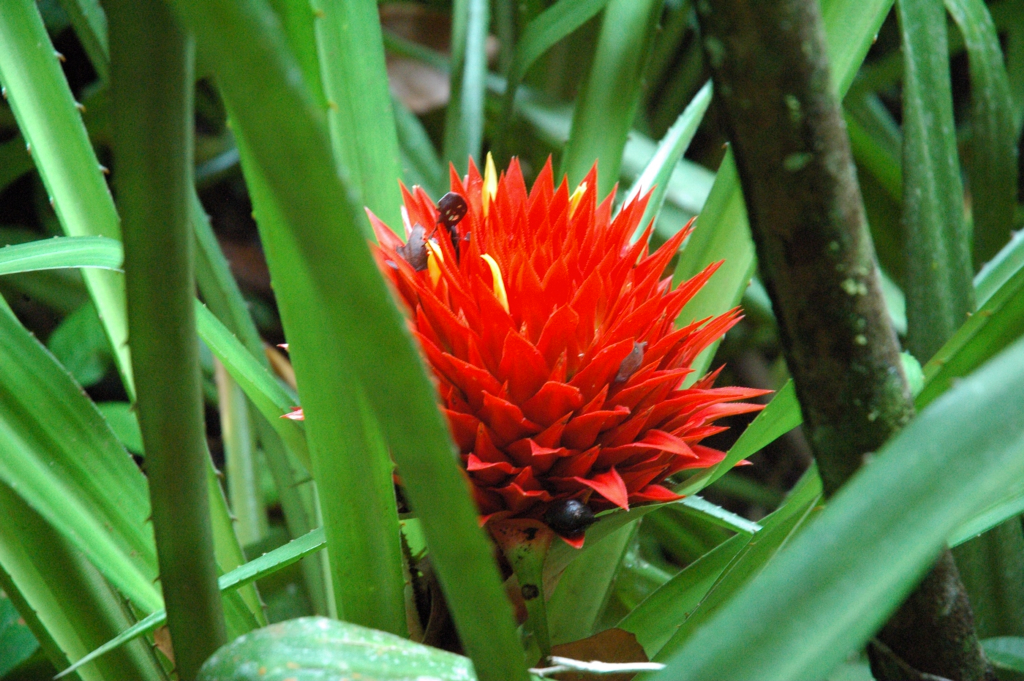
I decided to head back to the forest this morning determined to get some photos of the monkeys. I spent almost three hours in the thick of the forest, heard the Mantled Howlers but didn't see any monkeys. So instead I took some pictures of the flora.

I've not yet given up on the monkeys though. I'll buy more bug spray tomorrow morning and give it another go. Stay tuned...

I tried looking up all the flowers...this one is a type of wild ginger. I wasn't so successful with the others.


Above is a termite nest. Below is also some kind of nest, but I couldn't find a reference of it anywhere on the Internet. Some kind of wasp? It was growing on the trunk of a palm tree. If anyone knows what it could be, please send me an email.


Monday, May 14, 2012

The Versatile Coconut Tree

The five largest coconut producing countries are Indonesia, Philippines, India, Sri Lanka and Brazil. However, the natives of the San Blas Islands also rely on Coconut not only as a source of food, but also income, selling most of their harvest to Colombia.

It is not only the meat of the coconut they are after, although that is the most well known. The fruit, or nut is harvested for coconut water, oil, milk and shredded coconut as we know it. Coconut water which is naturally sterile until the coconut is opened, provides a nice, refreshing drink and is also quite good for you. The water contains sugar, fiber, proteins, antioxidants, vitamins and minerals and is said to be an isotonic electrolyte becoming popular as a sports drink. The coconut meat which we enjoyed eating directly from the fresh coconuts we bought, is usually dried and shredded and used in sweets such as Bounty chocolate bars and my favorite, macaroons. Coconut milk is also used in cooking, often as a complement to a curry dish. And of course, coconut oil is popular for frying or as an ingredient in cosmetics and soaps. Although coconut oil is high in saturated fats, the Organic Facts website makes a lot of claims as to the health benefits including weight loss. I let you do your own research on this topic ... I wish losing a few pounds were really as simple as eating more coconut. (http://www.organicfacts.net/organic-oils/organic-coconut-oil/health-benefits-of-coconut-oil.html).

The husk fiber of a coconut is used to make ropes, mats and brushes as well as caulking, stuffing and potting compost. We saw the fronds used for roof thatch for huts and shades here in the islands. They also burn the dried leaves and extract lime from the ashes. The timber or trunk of the tree is used for houses and boats.

And I discovered that the activated carbon in water filters is often from coconuts because although more expensive, it is more effective.

And now, a few more interesting but completely useless facts:

  • Coconut is grown in more than 80 countries.
  • The top ten coconut growing countries produce 56.4 million tonnes per year.
  • India produces 15,729 million nuts per year using 1.8 million hectares of land.
  • It takes about 90,000 nuts to make 1 tonne if activated carbon.

Wednesday, May 9, 2012

San Blas Pictorial

The San Blas are littered with over 300 islands, most of them uninhibited.

The Kuna ladies selling Molas from their ulu to our friends on Snowaway.


This island is clearly inhabited. We stopped in for a visit. I can say, they certainly live a simple life.


The Kunas are excellent seaman and travel several miles in their small dugout canoe with the help if a sail.


Our purchase of fresh coconuts. Delicious!


The perfect 'deserted island'. Two palm trees and a lot of sand. We brought along a hammock for Jens to fulfill his dream.


We bought a couple of freshly caught lobster for dinner. Cooked on the BBQ with butter, garlic and a little lime juice. Yummy!
Our trip in the dinghy up the Diablo River. We had a huge rainstorm the night before and the river turned a nice shade of brown. We didn't do the hike as intended, as it was a little too muddy.

The snorkeling around the islands was fantastic. I have never seen so many starfish. One time I counted 15 just in the area around me. We also saw a lot of conchs, and small baby conchs. Very nice!
Baby starfish
Baby conch


Fan coral with small fish swimming n front. There were millions of these small fish in the sea.


Kuna fishermen heading out for the morning.


Tuesday, April 24, 2012

Conchita

As we were hiking along the trail through the Sierra Nevada, Jens and I got to talking about donkeys and mules. They are two very different animals, but I didn't really know much about them. A donkey is different from a horse as you probably know. The visual differences are obvious. Donkeys are smaller, have longer ears, a short coarse mane and a tail similar to a cow with a tasseled switch. But what is the difference between a mule and a donkey? I knew that mules are larger, but Jens told me that a mule is an offspring between a horse and a donkey. We didn't know much else, and as I became a little curious I had to do a little more research.

These are mules as evidenced by the horses type tail.


Donkey, mule, burro, ass, jackass, hinny or moke?

Burro is the Spanish word for donkey but is also commonly used in the Western Hemisphere when referring to donkeys. A male donkey is a jack and a female donkey is a jennet. Ass, jackass and moke (which is British slang) are also referring to donkeys.


A mule on the otherhand is an offspring of a male donkey and a female horse, while an offspring of a female donkey and a male horse is referred to as a hinny. Both hinnys and mules are sterile. Mules are said to be smarter and less stubborn than a donkey and live longer and are more sure footed than a horse.


Famous donkeys and mules.

So who is Conchita? Conchita is the name of Juan Valdez' mule. Yes, she was a mule, not a donkey. Our all time favorite donkey is of course Eeyore from Winnie the Pooh. And then there's the donkey in Shrek that goes by the name Donkey (not terribly original, but it seems to work). My personal favorite is Francis the talking Mule that was played by Molly. I used to love those movies. :)


Tuesday, November 22, 2011

We covered 66 miles during this leg of the journey and are now anchored at Carolina Beach, NC.  We left early to try to get some distance covered since they are calling for some days with rain and wind.  We saw a lot of dolphins today.  Photographer Ev was not quite quick enough with the camera; I'll try to get some better shots next time.  We'll head out early again tomorrow.    Thanks to our friends for following along - welcome John.  Nice to see you.  It's been a while!