Showing posts with label The World Around Us. Show all posts

Saturday, November 24, 2012

Isla de la Plata, "the poor man's Galapagos"


Isla de la Plata (or Silver Island), is a small island off the coast northwest of Ecuador and is part of a National Park.  The island came by it’s name because this is where Sir Francis Drake had buried his treasure, but others say that it refers to the guano, or bird droppings, that cover the rocks and then shine in the sun and moon light, giving a silvery glow.  We stopped on our way to Ecuador and were given a tour of the island by the Park Rangers.


We now know what a Blue-footed Booby looks like and we know what their eggs and their young look like.  We had a fantastic close up look at dozens of pairs with their young as we walked along the island.  They are really curious looking birds.  So, as a result, I have lots and lots of photos of these guys.
A young Albatross


We also had the chance to see a baby albatross.  What a sight that was.  They are very large birds and the young chicks are also very large – and clumsy.  I know very little about these birds so I had to look them up and found some good information on the National Geographic website.  The adults have a wingspan of up to 11 feet (3.4 meters) They drink salt water and can glide for hours without rest or even flapping their wings thanks to their huge wingspan.  They live to about 50 years of age and gather only to breed.

Then we took a walk along the beach and saw a lot of red crabs and as this is a Nature Reserve, they also take care of the turtles that are laying their eggs on the shore. 


It was a great day, a chance to stretch our legs after 5 days at sea and a good break and a quiet night at anchor before we set off again for the next 4 days of the journey to Salinas, Ecuador.  

Wednesday, October 3, 2012

Playing in the San Blas

Thursday, September 27, 2012

The San Blas are an archipelago of more than 300 islands. There are an abundance of reefs providing some of the best snorkeling you can imagine. The sea is full of fish; tiny pin sized fish that are surely hatchlings, schools of small fish, and schools of medium sized fish. Then you have a few larger fish coming by now and then, but I think most of the bigger fish stay in the deeper water. The reefs are alive with your typical reef fish and all kinds of coral.

As you approach the sandy beaches of an island the bottom is littered with star fish. Too bad they're not edible because they certainly are plentiful. And they would be so easy to catch. I wonder how far they actually move in a day because they don't seem to move at all. But then, if they were edible, I'm sure there wouldn't be so many of them around.


The Kunas are superb skin divers and often bring their catch by our boat. We were snorkeling the other day and had the opportunity to watch a Kuna man and his son spear fishing. He was using a Hawaiian sling to catch fish and he was also hunting langoustines. These are essentially lobsters without the front claws. The tail makes for excellent eating and we've have had a couple of nice meals of these.

We see lots of spotted eagle rays and sting rays, plenty of conch and sand dollars (my collection of sand dollars is growing daily!) and in the empty conch shells, we find the new tenants - hermit crabs. There is evidence of crabs on every beach - you can tell by the numerous holes in the sand but by the time we get close they have all scurried back to their homes.

Oh, and did I mention the jelly fish? There are a lot of them this time around. We didn't see any when we were here in May. There are hundreds of small walnut sized jelly fish. Yes, they sting. It feels like a small ting and most of the time it is hardly bothersome. Jens seems to have a delayed reaction to their stings. He had several on both arms that swelled up and got a bit white and hard for a day or two. He now goes snorkeling with a long sleeved t-shirt. They don't seem to affect the rest of us. I try and avoid them anyway, especially the larger ones.

What shall we do today? Let's go snorkeling. What? Again? We did that yesterday and the day before that. Actually we've gone snorkeling at least twice each day for the past 14 days. Yup, I'm getting my fill of snorkelling. Time to move on I think.


Tuesday, September 11, 2012

Lightning Capital of the World?


We are in the middle of the rainy season in Panama.  That means it rains EVERY day!  The rainy season is a long one - May to November and Panama gets about 1900 mm of rain per year.  This compares to 773 mm in Toronto.  

The humidity is quite high and the amount of lightning is spectacular.  I have never seen so much lightning in my life.  After being here a few weeks and seeing lightning storms once, sometimes two times per day, I was sure this was the lightning capital of the world.  A little google searching and I saw a lot of claims that Florida was the lightning capital of the world.  But digging a little deeper I came across a great site by NASA.  And although Florida has the most lightning strikes in the USA, it is actually a small town in the Congo that hold the number one spot.  Below picture is courtesy of NASA - the redder the zones, the more lightning per square kilometre per year.  The amount and type of data that NASA collects is quite interesting.  They have a great website, but it is not so user friendly and they use a lot of very technical terms.  Anyhow - this is a good picture and gives you an idea of where the lightning hot spots are.


lightning flash scale

Wednesday, June 6, 2012

The Bridges to Aarhus

If you measure a straight line from Panama City, Panama to Aarhus, Denmark we have travelled 9,164 kilometres, crossed 7 time zones and have moved north more than 47 degrees.  The day time temperature has gone from 30+ degrees celcius to just around 15 degrees.  We are close to the land of the midnight sun now and it is light from around 4:30 AM to 10:00 PM.  

It has been such a good trip so far.  We've had the chance to meet up with dear friends in Sweden having no time to worry about jet lag with dinner parties lasting till the early hours of the morning three nights in a row.   A stay at the Hilton in Malmo helped to get us on the right track.  

On Monday, we drove from Lund, Sweden to Aarhus, Denmark crossing several bridges.  The newest of them is the bridge that joins Sweden's South coast to Copenhagen, Denmark.   The eight kilometer Oresund bridge was completed in 1999 and officially opened in 2000.    

This trip to Denmark, I hope to take some time to get to know the country of my partner a little more.  We'll have almost two weeks to visit with family and friends, celebrate my Mom-in-law's 75th birthday and explore the Danish countryside.  


Connecting Sweden to Denmark

The Great Belt Bridge


Lillebaeltsbro Bridge

Saturday, May 26, 2012

Turkey Vultures and Howler Monkeys

An early morning ride into the rain forest together with Jens, my good luck charm, resulted in encounters with Turkey Vultures and Howler Monkeys.  

First we walked through the old Fort Sherman residential area where the roads are slowly getting taken over by the jungle.  The buildings have all been taken down long ago leaving behind only the foundations.  

This time we were fully coated with bug spray and I was equipped with my Nikon D70S with the Nikkor 70-200mm zoom lens.  

Jens spotted some Turkey Vultures just ahead so we got off the bikes, and I walked slowly up as far as possible before they got spooked and flew off.  Such large birds!  Not the most beautiful of faces, but rather lovely in flight.
Turkey Vulture sitting on a fire hydrant.  There were three of them nearby.

I wouldn't want his claws anywhere near me!

Turkey Vulture flying off.  
We continued on and after a stop at the beach and some shell collecting, we rode further into the rain forest until we could hear the Howler Monkeys.  They were very close to the road and were on the move.  We stood and watched as a troop of about 20 monkeys moved through the tops of the trees from one side of the road to the other and then off deeper into the forest.  We were treated to their barks, howls, grunts and clicks.  They are almost as intriguing to listen to as they are to watch.


Howler Monkeys on the Move


The baby holding on to Mom and keeping an eye on us.


Baby on board!

The cojones swinging in the breeze  ;-)  


Saturday, May 19, 2012

The Sounds and Colours of a Rainforest

Shelter Bay Marina is right next to a National Park and what used to be a US Army base called as Fort Sherman. The national park is known for bird watching, butterflies, frogs, sloths and monkeys. We've been here over a week and it was time to explore.

Jens and I took a bike ride down the road towards San Lorenzo hoping to spot a sloth. We heard the usual forest sounds of birds, insects and frogs. And then we heard the Mantled Howler. Their loud grunts and roars are something out of a horror movie. We stopped to listen for a while and although we couldn't see the Howlers we spotted some White-faced Capuchins in the trees. Unfortunatley we forgot the bug spray and the Mosquitos soon found us, forcing us to retreat back to the road and back on the bikes. We tried to spot a Toucan, but just saw a lot of butterflies. The easiest to identify are the Blue Morphus Butterfly. They are really beautiful to watch as they flit along, but so very difficult to photograph.

I decided to head back to the forest this morning determined to get some photos of the monkeys. I spent almost three hours in the thick of the forest, heard the Mantled Howlers but didn't see any monkeys. So instead I took some pictures of the flora.

I've not yet given up on the monkeys though. I'll buy more bug spray tomorrow morning and give it another go. Stay tuned...

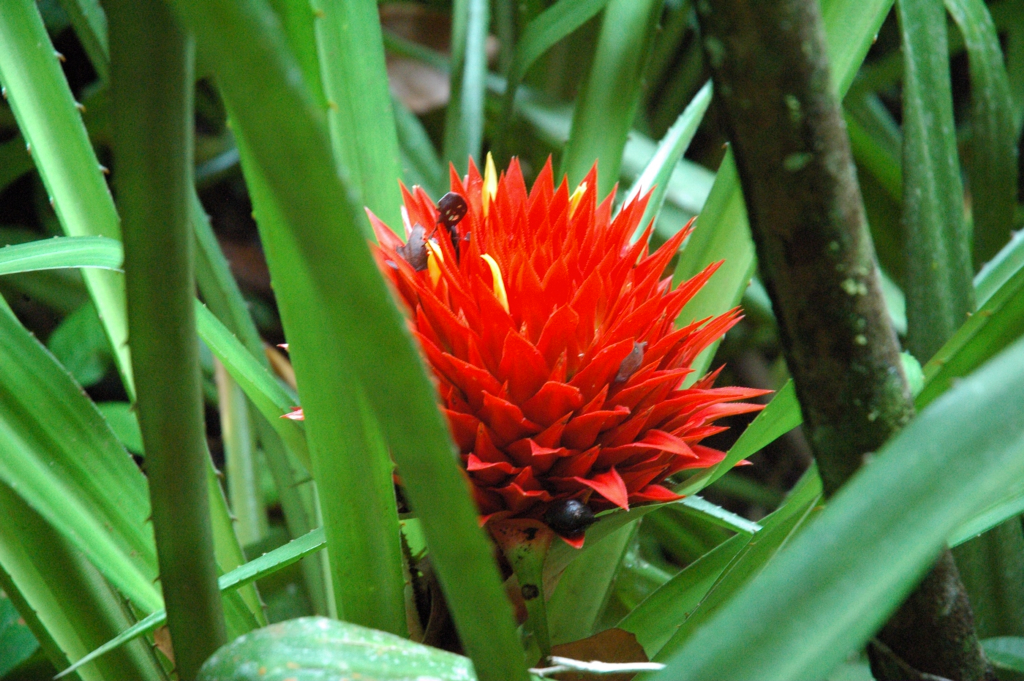
I tried looking up all the flowers...this one is a type of wild ginger. I wasn't so successful with the others.


Above is a termite nest. Below is also some kind of nest, but I couldn't find a reference of it anywhere on the Internet. Some kind of wasp? It was growing on the trunk of a palm tree. If anyone knows what it could be, please send me an email.